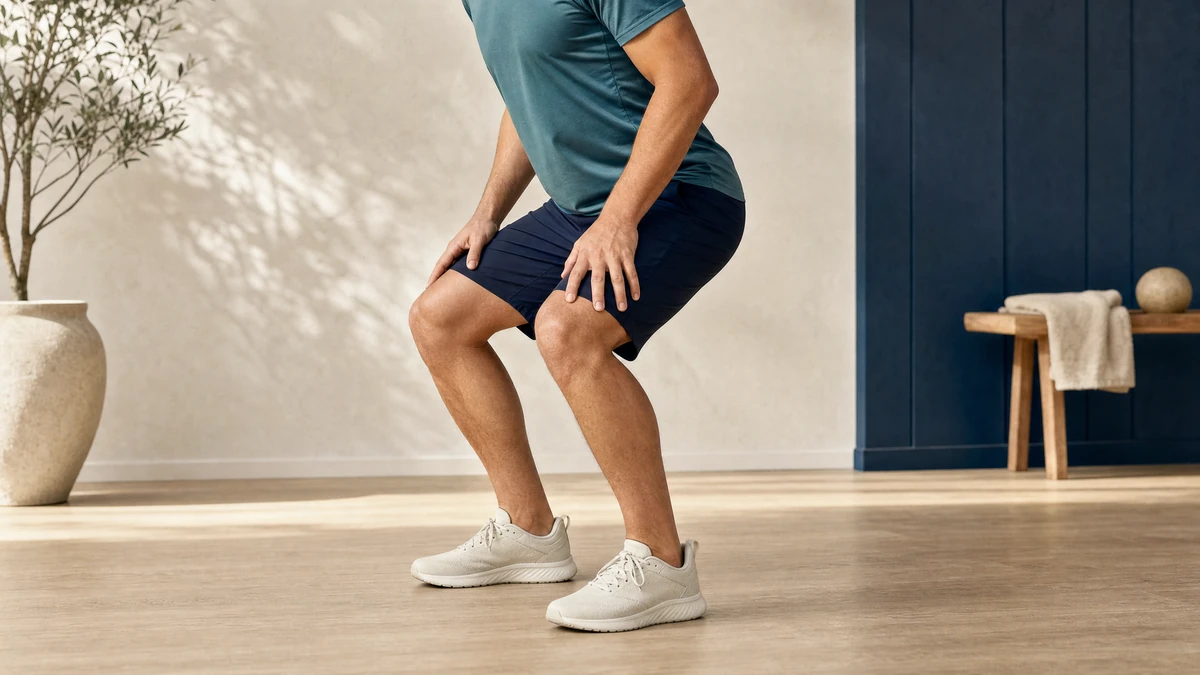
Knee pain when bending or squatting can have different explanations. Patellofemoral pain is one possibility, especially when discomfort is at the front of the knee and occurs during activities involving loaded flexion. But the painful movement alone does not identify the responsible structure or confirm a cartilage injury. [1]
Rather than trying to name the problem online, it is more useful to understand the pattern: where it hurts, at which point in the movement, with how much effort, and with which associated symptoms. These observations help guide assessment and activity adjustments without turning every squat into a threat. [1][2]
Bending while seated and squatting are different situations
When squatting or rising from a chair, flexion occurs while the leg supports the body and the muscles produce force. Bending the knee while seated, without the same weight-bearing demand, is a different task. In the assessment of patellofemoral pain, tolerance for loaded flexion is important information, alongside strength and how the movement is performed. [2]
It helps to describe whether discomfort occurs on the way down, on the way up, or only at the deepest point of the movement. It also matters whether it happens without additional weight or only during more demanding training. You do not need to provoke pain repeatedly to find the limit: describing what already happens in daily life is usually more useful than turning observation into a home test. [1][2]
Location guides the question, not the answer
Pain at the front of or around the patella, the kneecap, can occur when squatting, using stairs, or remaining seated with the knee bent. This pattern is consistent with patellofemoral pain, but other conditions also cause symptoms at the front of the knee. Location should be interpreted together with the history and examination, not as a map that can provide the diagnosis. [1]
Discomfort near the tendon below the kneecap, for example, calls for different questions from pain that began after a twisting injury, accompanied by swelling or difficulty straightening the leg. It is this combination that changes the investigation. Trying to conclude that the problem is the meniscus, tendon, or cartilage solely from the painful spot can lead to inappropriate treatments and delay the assessment that is needed. [1][3]
Patellofemoral pain does not automatically mean chondromalacia
The terms often appear together, but they do not mean the same thing. Patellofemoral pain describes a clinical condition related to the region of the kneecap and femur. Chondromalacia describes softening and changes in the cartilage on the back surface of the kneecap. A structural abnormality can coexist with pain, but it does not have to be present for the painful condition to exist. [1]
This is why pain when squatting does not allow the conclusion that cartilage is wearing away with each repetition. Nor is it appropriate to ignore a relevant imaging abnormality. Clinical reasoning seeks to establish whether the finding explains the complaint and whether it changes management. Pain intensity should not be used as a direct measure of the extent of damage. [1][2]
Recent loading may explain part of the change
The knee may start to hurt after an increase in activity frequency, duration, or intensity. In patellofemoral pain, exploring these changes helps explain the relationship between demand and tolerance. This applies to sport and everyday tasks: the person’s context matters as much as the name of the exercise. [1][2]
Load management does not mean choosing between stopping everything and pushing on without limits. Depending on the assessment, it may be necessary to modify movement depth, weight, number of repetitions, or frequency while preserving tolerable activities. The response during and after the task helps guide adjustments. These are possibilities for individualization, not a prescription for everyone to make the same changes. [2]
Squatting does not warrant a universal ban
There is no single version of a squat suitable for every knee, just as pain does not justify a permanent ban for everyone. In patellofemoral pain, task selection and progression should consider symptom irritability, muscle capacity, and the person’s goals. Repeatedly forcing a painful range of motion is not a requirement for improvement. [2]
The best practice guide published in the British Journal of Sports Medicine in 2024 places education and therapeutic exercise at the foundation of patellofemoral pain care, with work directed at the knee and, when indicated, the hip. This requires assessment: exercises, intensity, and progression are adjusted. Foot orthoses, therapeutic taping, and other strategies may have a supporting role in selected situations, not as a mandatory solution for everyone. [2]
Assessment determines which questions need testing
The clinician considers symptom onset, trauma, activity changes, mobility, strength, stability, and tasks that provoke discomfort. Observing a movement helps explain function, but should not be used to attribute all pain to an isolated postural detail. Treatment needs to be based on the full set of findings and on the limitations that truly matter to the person. [1][2]
Imaging tests are chosen according to the suspected diagnosis and what they need to clarify. They are not a mandatory shortcut for every case of pain when squatting. For osteoarthritis, for example, NICE emphasizes that assessment is usually clinical and that symptoms and function should guide care. Suspected other injuries, atypical features, or unsatisfactory progress can change the need for investigation. [1][4]
Some signs change the urgency
Very severe pain, inability to bear weight on the leg or move the knee, deformity, and substantial swelling warrant urgent care. A hot, red knee with fever or feeling unwell also requires assessment without delay. It is not prudent to try to manage these situations simply by reducing the training load. [3]
Locking that prevents movement, significant giving way, or a painful click also warrant prompt guidance, especially after an injury. This differs from an isolated, painless noise, which can occur without indicating disease. Without warning signs, persistent or recurrent pain, or pain that starts to limit daily life, calls for a scheduled consultation rather than months of adjustments made without a diagnosis. [3]
Frequently asked questions
Do foot orthoses have to be custom-made to help?
Not necessarily. For selected people with patellofemoral pain, the best practice guide includes prefabricated foot orthoses as a supporting measure, considering the response to a functional task and comfort. This does not mean that every case of pain when squatting needs foot orthoses, or that this measure replaces assessment and active care. [2]
Does pain when squatting mean I will need surgery?
No. The symptom alone does not indicate surgery. For patellofemoral pain, care is usually non-surgical, based on education, exercises, and individual adjustments. Any indication for an operation depends on a specific condition demonstrated through assessment, not simply on persistent pain during a movement. [1][2]
Conclusion
A painful movement offers a clue; it does not deliver a verdict on the knee. The safer pathway is to understand the task, load, and context, investigate what needs clarification, and rebuild the ability to move with professional guidance. Neither fear of bending nor persistence at any cost: information and assessment allow more proportionate decisions. This text does not replace an individual consultation.